

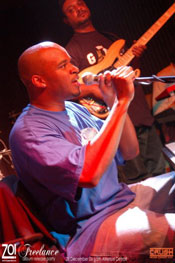
 The adage “You don’t know where you’re going unless you know where you’ve been” holds true in virtually everything, but it’s especially relevant in music. Detroit producer/multi-instrumentalist Zo! has followed this mantra throughout his entire career, and it’s served him well. Respect for his predecessors has enabled him to re-play classics as a member of the Guerilla Funk Mob live band, provided him with a palette for his various remix projects and beats for Michigan’s elite emcees, and given him material to educate special education high school students as a teacher in Washington, D.C. Peer-to-peer reverence between him and Little Brother’s Phonte spurred the newly-released “Zo! And Tiggalo Love The 80’s,” an EP that sees the duo covering hits from the likes of Toto and Joe Jackson. In an interview with MichiganHipHop.com, Zo! talks about working with Phonte, the ridiculous album cover, and knowing where you come from.
Personally, I know of you, and some of your stuff, but I don’t know a lot about you. How did you get started in music?
I was just brought up around a lot of music. I guess a lot of peoples’ upbringing came through piano lessons and that type of thing, so I started taking piano lessons early, when I was five or six. I used to hate it. When you’re a kid, you’ve got a lot of energy, you don’t have a lot of time to be sitting around and practicing scales; you want to run around. I stuck with it, and basically, being exposed to a lot of music [contributed as well]. My mother played piano, and my father played guitar. I just pretty much fed off of everything that they listened to, one way or another. It was an early introduction.
How did you get involved with Guerilla Funk Mob?
I still do work with them. I know a lot of the talk when I left the Detroit area is that the Funk Mob was breaking up, but the Guerilla Funk Mob is still together in full force. I still work with them. I just talked to Tate yesterday. We’re still doing our thing together. The Funk Mob was a wonderful experience for me, because as far as being onstage, I didn’t have experience. My first time being onstage was in ’03, and to be onstage and to give a good show onstage requires experience. It’s not anything where you can just hop up onstage and be like, “I’ll rock the crowd.” Nah, not really. You’ve really got to be experienced, and being able to be with a band that had a consistent personnel and being able to lock into cats like me and the drummer Tate, the bass player G-Rock, and the keyboard player Mikus … we could all get on stage right now without rehearsal and just lock in, because we’ve been able to develop a style and we know what each other is going to do. It gave me a foundation of live instrumentation, and it also gave me more of an appreciation for what people do on stage and how much practice goes into it.
You guys performed with a lot of rappers, too, who would freestyle over your instrumentation. What would you say are some performances that really stick out as highlights?
I really like performing with high energy cats. We’ve done stuff with Finale and Invincible that was dope. One of the first freestyle sessions that we performed at Carbon Lounge, when it was Carbon Lounge, was crazy. That was ridiculous. Everybody was just into it, and nobody knew what we were going to do. I’m trying to remember if it was just me and Tate, I can’t even remember. But we were just pulling out songs: O.C.’s “Time’s Up,” different Slum joints. All of them are pretty memorable to me, because I just love being the DJ, so to speak, where you just pull out a joint and hearing the crowd’s reaction hypes you up.
Let’s talk about this project with Phonte. First off, how did you guys come across each other?
I was familiar with Phonte of course, him being with Little Brother. I got their The Listening album at the end of ’02. As far as thinking, “Yeah, I’m really going to be working with that dude,” that never even crossed my mind. Fast forward to ’05, a couple things happened. I did a couple of remixes for my Re:Definition album, and two of them had Little Brother acapellas on it. From what I understood, he heard ‘em, or they both heard ‘em. I was trying to get in contact with Median, who is one of the emcees from the Justus League camp, and I ended up sending him a CD of different beats and music. I’m not sure if Tay heard it from that; he told me heard it from Passion of Re:Definition, but I’m not sure exactly who gave it to him. We ended up meeting face to face when they performed in Ann Arbor that same year, in ’05. I stepped to him, like, “What’s up, I don’t know if you know who I am,” blah blah blah. He’s like, “Nah, I know who you are. I got your shit in my iPod.” I’m like, “Word?” From that point, it was kind of like a mutual respect thing. I’ve always dug what he and Little Brother were doing, and to my surprise, he was feeling what I was doing. It was kind of crazy.
I was actually in the middle of working on Just Visiting, another remake album that was only pressed on vinyl. I did “Steppin’ Out,” by Joe Jackson. I was like, for the hell of it, let’s see if (Phonte) wants to sing the hook, just throw it out there as an idea. He’s like, “Shit, send it to me.” … I sent it to him, I taped the verses, he sang the hook, and that was the start of it. After I moved out here, we worked on “Africa” together. “Africa” came up from a conversation we were having. We’ll sometimes hop on the phone or hop on the IM, and have these two-, three-hour long conversations about music. So we’re going back and forth talking about different songs, and we came up on Toto’s “Africa.” We started buggin’ like, “Can you imagine the harmonies on there?” I’m like, “I’ve already got a drum track that reminds me of the joint, so I’ll send you a little dummy track, and you can sing on it.” So I sent it to him, he sang on it, and I’m sitting here buggin’ out, like, “This is dag-on Phonte, who’s ill on the mic, singing.” It took me listening to it like three times for it to sink in, and for me to call him back, like, “You a dag-on fool, man.”
With the response we got from “Africa,” our goal was just to keep working. Both of us were in between albums, and our vision was just to stay sharp in the studio. With live performing, if you want to stay sharp you’ve got to keep doing it. It’s the same in the studio. If you want to stay sharp, you’ve got to keep creating. Especially if you’ve got another cat that’s just as much of a perfectionist as you are, someone to stay on you or to impress, so to speak. We don’t want to mess up in front each other. That type of respect and competition.
Could you talk about “Africa” a little bit more, and how that happened? That was one of my favorite joints from you guys.
For cats who don’t know or cats who are teenagers now, you’ve got so many different subcultures and subgenres of Hip Hop, it’s so easy to get stuck in that one frame of mind. Like, “All you can do is Hip Hop, and that’s it. Fuck everything else.” If you were growing up in the 80s, and you were exposed to so much more different types of music…I’m exaggerating, but there were only like four rap groups, you know what I mean? There was no “106 & Park,” there wasn’t no “Yo! MTV Raps” yet. So you’ve got Run-DMC doing their thing, you’ve got Houdini, you’ve got LL, you had Kurtis Blow who was doing his thing, and that’s about it, know what I mean? Hip Hop was just “Hip Hop,” but outside of Hip Hop, you had all these other different cups of music that you were exposed to. It’s kind of like, we’ve been exposed to all this music, and this is our appreciation for it. We picked “Africa” first, because “Africa” was something I had always liked. If you’re a cat now, telling your boys that are 17 that you like such and such that’s not Hip Hop, they might clown you. But back then, they’d say, “I’m feeling that joint too, check this one out too,” because that’s what you heard. Everybody got a chance to hear “Africa;” if you play “Africa” at a party right now, everybody knows that hook. You play “Take On Me” at a party, everybody already knows that hook. Whether they admit to it or not, when that hook comes on, you better believe it’s going to be a sing-along.
We were just trying to take the most unexpected, left-field joints, and try to put our own spin on it. With “Africa,” we wanted to put our own spin on it at the end. I remember that distinctively, because when we first put his vocals on it, he just did the song part. I hadn’t done change yet, so when he did the vocals on the song part, that’s when I constructed and built the song around that. I added the change, and I sent it back to him. Like I said, we stay on some competitive stuff. So I’m like, “All right, you ‘gon sing like that? OK, here you go, deal with that.” He hit me up, like, “Man, you wildin’.” Then he ended up flipping the change. So I was like, “Damn.” [laughs] “Now I’ve got to add some more.” We’re constantly trying to one-up each other. It was real cool to see people responding to it the way that they did once we leaked it out there.
Where did the idea of making an entire album like this come from?
I think we started talking about doing an entire album after we did “Take On Me.” “Take On Me” was almost like, “You know what? Let’s see if we can take the most super-commercial, non-black…something that folks wouldn’t ever think we would recreate.” That’s where “Take On Me” came from, and we’re like, “Let’s just do it.” Folks were responding pretty well to that one too, so we were like, “Maybe we should make an EP.” At the time, we had three of them: “Africa,” “Steppin’ Out,” and “Take On Me.” It just seemed like the right thing to do, the natural progression of the direction of what we were doing. Let’s still keep it fun, but let’s work toward an alternate goal.
Y’all were foolin’ with the cover.
[laughs] We shot that right here in our apartment, man. We were clowning. Mussinah, a singer and producer from D.C., ended up picking out all the gear for us. She was going around, and came back with this full wardrobe. She’s like, “Just give me your sizes and I’m good.” She came back with this full wardrobe, down to the earrings we wore. It was crazy, man. We ended up snapping pictures, my wife is on the couch rolling. Her and Mussinah were having a good ol’ time crackin’ up at us. With the album cover, we were like, “We’re either going to do this, or we ain’t gon’ do it. We’ve got to go all out.”
It’s funny, because through all the curls, it really captures both of you guys really well. Every time I see Phonte he’s clowning, and every time I see you at a show, you’re just looking at it, concentrating.
The funny thing about it is that we’re both comedians. It’s just that I’ve got to be around cats I’m real comfortable with. If I’m at a show and it’s before the show, then I look like I do on the cover. If it’s after the show, I’m clowning. For real, for real. I don’t even drink before shows, because I don’t want to be up there sounding like an asshole. We laugh at the contrast, because that’s how they did in the 80’s! You have the cat that’s clowning as the front man who has all the personality, and you have the serious musician type. It’s funny that you pointed that out.
You really have a love and a talent for doing remakes—to take something that’s already dope or already there, and change it. Where does that come from?
I think the appreciation for music in general. I’m a music teacher, I teach music during the day at the high schools in D.C. What I teach to them is respecting their history first and foremost, because a lot of it what’s lost in the music today is the acknowledgement of history. If you hear me doing a “Caught Up In The Rapture” remake, you best believe it’s not going to see the light of day unless I feel like it’s me respecting Anita and what she did. That’s a joint I grew up off of, that’s something that I would hear being played in my father’s car every time I set foot in it. So for me not to do that joint any type of justice at all, in my mind, would be disrespectful. So it’s more or less an appreciation and a respect for the art, letting your guard down, being loose and having fun. That’s another thing that’s being lost in the mix a little bit; cats be brimming, and they’re scared to have fun anymore. Let’s have some fun. We all love these songs, and that’s not anything that I’m making a salary off of; that’s why we leak the music. We have fun with it, so have fun with us. Plus, it’s a learning experience. Something about your favorite song makes it your favorite song, so once you get to dissecting each part of the music, you might get to learn something. Maybe it was that chorus change, or maybe it was the type of instruments or the type of filter effects that they used. Maybe it was just her voice. You get more familiar with the music when you recreate it.
How does your teaching affect your overall perspective on music?
Number one, you get to see where you were at at one time. Teaching in itself requires patience, and this is a special ed school. These are kids who have so-called behavior problems and that kind of thing, but a lot of these kids have a tremendous amount of artistic ability. So once you get past all the little frontin’ that some of them like to do once they come in here, you’re like, “Wow, my man is doing his thing on the keys.” I’ve literally seen kids do a 180 because of their interest in music. I can think of one in particular who did a complete 180, is getting ready to graduate next year. It’s just unbelievable, man. It’s really encouraging.
On top of that, you learn a lot. I don’t know if I learn more or teach more. You learn a lot about yourself as far as patience goes, and you get to learn from the kids why you’re teaching. If you’re teaching somebody something from scratch, that means you have to verbally explain to them, all the way down to the bone, what’s second nature to you. So that was an adjustment to me in itself. You can sit down and play, and you know what’s going on, but can you actually explain what’s going on, and explain it to some kids who may or may not want to be there? It’s interesting, man. It’s definitely not a job where you come and it’s just the same 9-to-5 every day. You don’t know what you’re walking into. It definitely keeps you on your toes as far as that goes, and it keeps you on your toes as far as keeping your skills up. I’m like, “Shoot, if I get to stay there long enough and groom a kid to where he’s really picking it up and he’s taking it home and he’s coming back and getting better, wait a minute, he’s not supposed to be passing the teacher.” And it keeps you on your toes as far as terms for musicians, too. Teaching keeps you sharp, for sure.
You’ve collaborated with a lot of cats. If you could make your fantasy track with three emcees from Michigan, who would they be, and why?
Tough one, damn. Wow. [sighs] You ain’t even gonna give me five, that’s messed up.
[laughs] You can list five if you want. That’s a long track, though.
I know, maybe they’d have to do eight bars a piece. It would be Elzhi, because that’s my man, he gets it done. Period. He’s my favorite out of Michigan, emcee-wise. Him, Finale, Lo, Asylum 7, and for good measure, I would say Royce. All five of them are just ridiculous, period. I don’t know the order, I’d let them have that out. With that amount of talent, I’m like, “You know what? I’ll just concentrate on the music here, and you can all get together and hash it out on that side.” But you can’t go wrong.
I’m actually working with Asylum 7 now on an EP. I thought my work ethic was something, but A7’s work ethic is ridiculous. He’s got a turnaround rate on a beat that’s ridiculous. You send him something, and 48 hours later, he’s like, “All right, where’s the next one at?” That’s why I like working with that dude. Finale, I mean you’ve heard Finale, he’s ridiculous. When somebody says such and such is a beast, I’m like, “All right, you’ve got to hear Finale, because dude goes to war in the booth.” Elzhi, with the wordplay, is second to none. Lo is so clever with his rhymes, you’re like, “Wow.” You’ll be sitting there eight months later after a new release, and you’re like, “Wow, that’s that he said. OK, bet. I just got that.” [laughs] Royce is another animal in the booth. So I think those five, since I cheated, will be the ones.
Zo! & Tigallo “Love The 80’s” can be ordered at FatBeats.com
Fantasy iTunes List For Week 1-25-09 - Michigan Hip Hop Edition « Speech Is My Hammer… says:
[…] it comes to hard work, you won’t find many Michigan hip-hoppers better than Zo! and Asylum 7. Zo! has been holding it down for years, both as a live musician with Guerilla Funk Mob and as producer […]
January 23rd, 2009 at 12:32 pm